Recently adopted jail standards in Colorado have direct impacts on operations, as they pertain to detainee services and how staff operate within the physical facilities. County Sheriffs across Colorado are finding that these requirements also have implications for planning, design, renovation, and expansion of detention facilities.
In 2022, the Colorado Jail Standards Commission was created with the goal of setting baselines for jail conditions, out of a need to balance the rights, humanity, and dignity of persons experiencing incarceration with safety and security, create consistency across counties while still allowing for individuation, and create a framework for implementation and enforcement.
In 2024, the jail standards were adopted, and they will go into effect on July 1, 2026. The commission anticipates a staged or tiered implementation of the standards, and the creation of a variance procedure that allows jails to request specific and reasonable variances to specific standards.
The Bottom Line
The recently adopted jail standards in Colorado may encourage upgrades or retrofits in order to address requirements. Facilities in the future may trend to be:
The standards could have important considerations in these five key areas:
1. Housing Unit Space Planning & Design
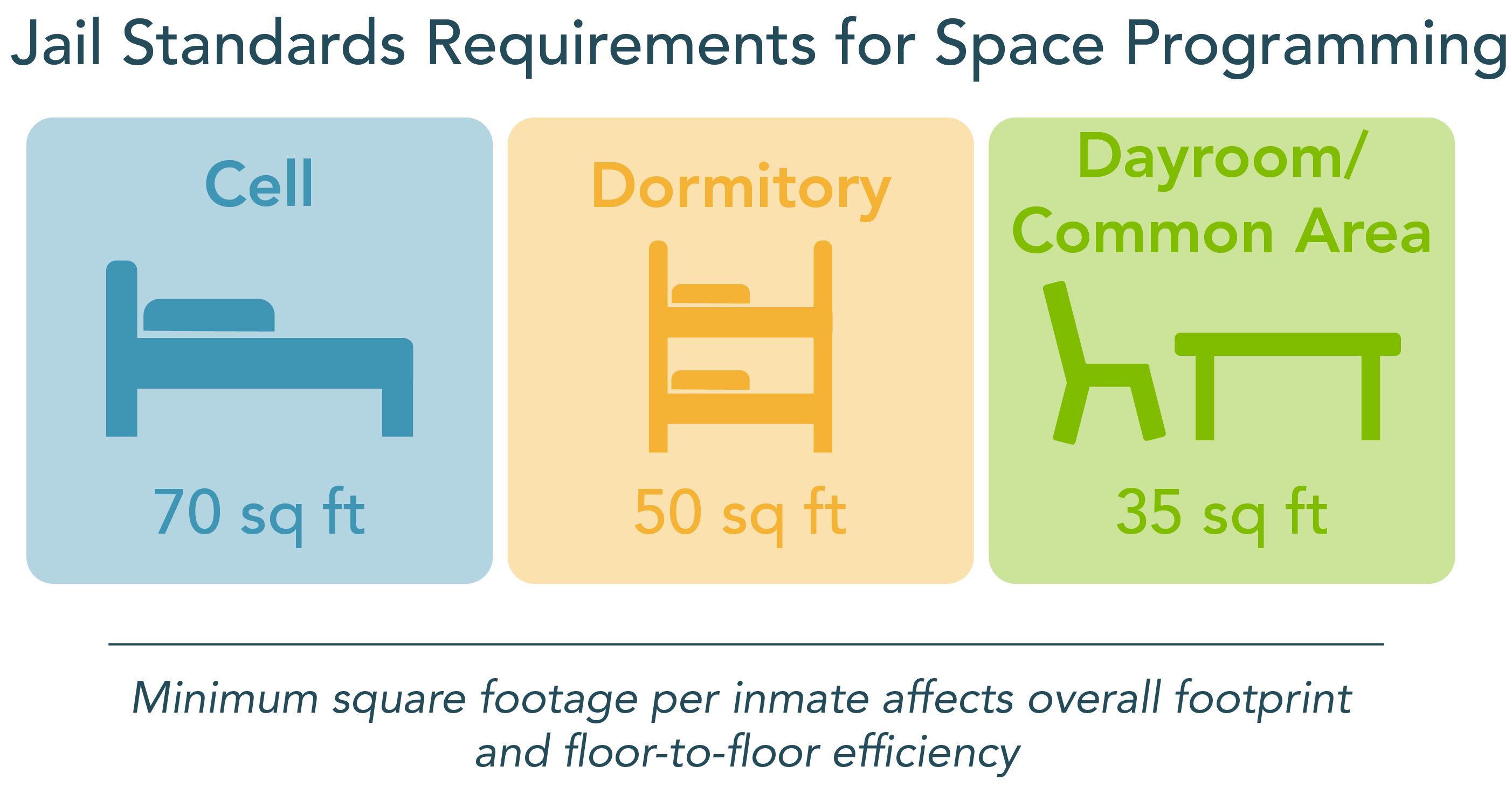
The standards prescribe minimum spatial allowances that strongly influence building size and layout, emphasizing direct supervision and humane conditions.
What could this mean? A larger building, a more compartmentalized layout, increased secure glazing and careful adjacency planning to reduce staff movement and inmate transport.
2. Security, Life Safety, & Code Compliance
The standards promote levels of security appropriate to inmate classification, as well as fundamental code compliance for life safety, fire protection and emergency response features.
What could this mean? Complex coordination between security and life-safety systems, often increasing wall and door fireratings as well as increasing mechanical and electrical spaces. Careful architectural and engineering details to balance durability and dignity. Older facilities may need substantial updates to meet the requirements.
3. Health & Welfare of All Detainees
The standards reflect modern correctional best practices to support the health and wellness of individuals who are incarcerated.
What could this mean? Specialized unit design, non-institutional finishes where possible, ligature-resistant detailing, and increased demand for behavioral-health-focused spaces. Larger window openings with secure glazing, mechanical system zoning, acoustical treatments, and exterior secure recreation yards may need to be integrated into site planning.
4. Operational Efficiency & Staffing
Standards indirectly influence architecture through staffing and supervision expectations.
What could this mean? Compact housing pods, centralized control rooms, stacked functional zones, and clear separation of public, secure, and staff-only circulation.
5. Renovation & Expansion Constraints
For existing jails, compliance to the standards will drive major architectural decisions.
What could this mean? Additions rather than interior retrofits, phased construction strategies, and sometimes full replacement as more cost-
effective than renovation.
Download the PDF version below: