
The State of Colorado’s updated Jail Standards take effect on July 1, 2026. For commissioners overseeing facility assessments, bond planning or active design work, these changes will directly affect housing layouts, behavioral health spaces, suicide prevention features and staffing models.
The window to act is now and Wold is here to help. County leaders can protect taxpayer dollars and prepare for the coming changes to reduce the risk of redesigns and project delays. Projects already underway must validate their programs against the new requirements to avoid rework and compliance challenges. Our team is here to help leaders understand what is changing and how it will impact scope, funding and timelines to ensure facilities are positioned to meet evolving safety and wellness expectations.
We recently chatted with Bryan Hicks, an associate in our Colorado office with deep expertise on government facility improvements, to talk about considerations for humane design in justice facilities, how they improve behavioral and operational outcomes and how recent updates to state standards in Colorado will impact the future of secure environments across the country:
Beyond their specific requirements, the new standards reflect an accelerating trend in the field: jails are not just security facilities, but public health environments. The volume of requirements around mental health screening, suicide prevention, behavioral health access and restrictive housing limitations reflects the reality that a large share of people in county jails have significant behavioral health needs. Colorado has translated that reality into enforceable compliance obligations, ones that simultaneously drive minimum space requirements, operational standards and programming expectations. That combination creates real capital planning consequences for counties.
The legal exposure driving these standards matters too. Suicide, medical neglect and use of force liability have pushed jails into courtrooms across the country. Facilities that cannot demonstrate adequate space and programming for behavioral health needs face a growing risk. Often, they must also confront compounding pressure from staffing and retention issues, as it is challenging to recruit and keep qualified staff in facilities that are physically difficult to operate.
Over the next decade, I expect facilities to continue moving toward environments that actively support treatment, programming and successful reentry. Architecturally, that means housing unit configurations that support treatment adjacency, flexible program spaces that serve multiple functions and layouts designed for adaptability to support evolving population needs and standards. Planning will become more interdisciplinary, with mental health clinicians and community organizations at the table earlier. Colorado is part of a broader national shift in this direction, and counties that get ahead of these changes now will be better positioned, both financially and legally, than those that wait.
The new standards don't just affect cell sizes. For future construction, they require private space for medical and behavioral health treatment, sufficient visitation space with free in-person visits, dedicated programming and education space, and staff support areas. When those requirements are added to a building program alongside updated minimums for cells and dayrooms, the cumulative effect on square footage can be meaningful. In our experience, that impact can be significant before you've changed a single operational element, and counties in the middle of a needs assessment or bond planning process need to be accounting for it now.
It's also worth clarifying what "direct supervision" means in practice. Colorado's standards don't mandate that officers be stationed inside dayrooms. What good design achieves is that staff can monitor housing units effectively without blind spots. The way we approach that is through layout: designing control points so one officer has unobstructed sightlines into every dayroom and every cell door they are responsible for, without needing to leave the station. When done well, the layout does the security work, and that has real implications for long-term operational costs and staffing efficiency.
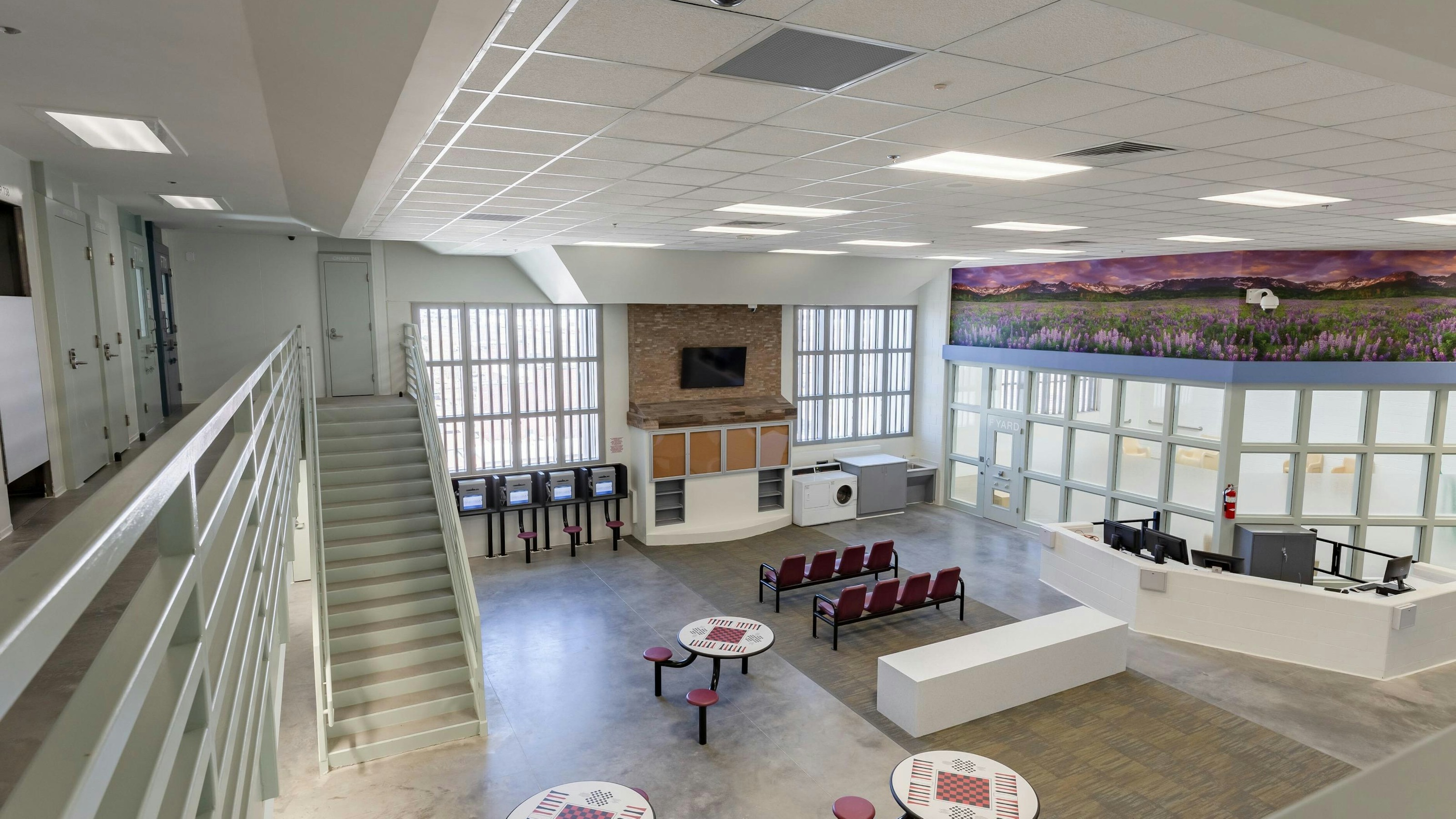
This is the central design challenge in modern justice facilities. We have found that the features that support wellness, natural light, clear sightlines, calm and organized environments, also tend to reduce incident rates. A facility that feels less chaotic is generally safer for everyone inside it, including staff.
That said, staff safety must be a primary design lens, and it deserves more weight in this conversation than it sometimes gets. Factors like sightlines, control point placement, material durability and how staff move through a facility during both normal operations and an incident must all be considered. These are staff safety decisions as much as they are design decisions. These empower staff to manage their environment proactively, not reactively. Together, they can help create a space where wellness and security stop competing and start reinforcing each other.
The shift has been significant, and it touches every phase of a project. At the planning stage, we are having conversations about mental health diversion and what percentage of the population has acute behavioral health needs. These discussions directly shape what kind of programming infrastructure a facility needs, including specialized housing units or clinical space. Colorado's new standards require access to behavioral health professionals, medication-assisted treatment for opioid use disorder and continuity of care that extends to post-release planning. Designing without accounting for those requirements produces facilities that are out of compliance before they open.
At the design level, suicide prevention has moved from an afterthought to a primary driver of spatial and material decisions. Colorado's standards explicitly state that incarceration heightens suicide risk, and most deaths by suicide occur in people with no known mental health condition. That language has real design implications: ligature-resistant hardware, breakaway fixtures and the elimination of anchor points can no longer be limited to observation cells. Expectations around restrictive housing have also shifted substantially. The standards require maximizing out-of-cell time, meaningful human interaction, even for those in restrictive housing, and documented justification for placement. That policy changes how those spaces are sized, located and connected to the rest of the facility.
Almost everything about how the building relates to the people inside it would be different. A jail from the late 1990s often emphasized separation and remote supervision, with officers observing from linear corridors and centralized control rooms physically removed from housing areas. Today, the design premise has shifted: podular or modified housing configurations place staff positions adjacent to or within sight of the housing unit, so that layout and sightlines do the security work rather than distance and barriers. That reduces reliance on movement, escorts and reactive staffing, which drives long-term operational cost as much as anything else in the building.
The spaces themselves would look different, too. A facility designed today will have larger cells and dayrooms, areas to support behavioral health services and clinical treatment and purpose-built rooms for programming and education. Classification would be more refined, with housing configurations designed to separate populations appropriately and adapt over time as population needs change. Flexibility is now a planning priority in a way it simply wasn't in the 1990s.
The relationship between the facility and the broader community would also look different. Modern jails are increasingly designed with reentry in mind from the start, with capacity for flexible programming, visitation environments that don't feel punitive, and adjacencies that support connections to outside service providers. A facility designed today under Colorado's new standards isn't just a holding environment. It's the beginning of a treatment and transition continuum, and that's a fundamentally different brief than what was driving decisions 25 years ago.